Dobro.rf: 13 times more requests per second

- Role
- Frontend Team Lead
- Team
- 15 people: 5 frontend, 4 backend, 2 designers, 2 QA, a PM and a DevOps engineer
- Timeline
- Since March 2026
- Status
- In development, launch planned for Q1 2027
What I did
- CodeThe codebase has 37 pages, 20 of them in the accounts, and 110 reusable components covered by tests. I wrote the UI kit and form fields, the accounts of non-profits and donors, the non-profit and fundraiser pages, the home page, the catalog, the header and footer, and the moderation section myself.
- The teamSet tasks and priorities for four frontend developers, reviewed and merged PRs. Wrote the guidelines and the onboarding document so new developers get into the project faster and write code in one style.
- Architecture and stackChose the stack and laid down the frontend architecture. The client set React, and Next.js on top of it serves the fundraiser and non-profit pages ready-made from the server: search engines find them, and a donor sees the fundraiser at once, without waiting for it to load. Strict TypeScript with no any and no as casts catches errors before release, which matters where money goes through the site. Components are split into layers ui → form → base → pages, Server Components by default, and every component has tests.
- PerformanceThe site handles 13 times more requests per second, and the server prepares a page in 69 ms instead of 919. For a charity platform this means the site does not slow down when many donors arrive at once, for example after a newsletter or during a big campaign. I did all of the optimization myself, from measurements to the report.
Context
Business
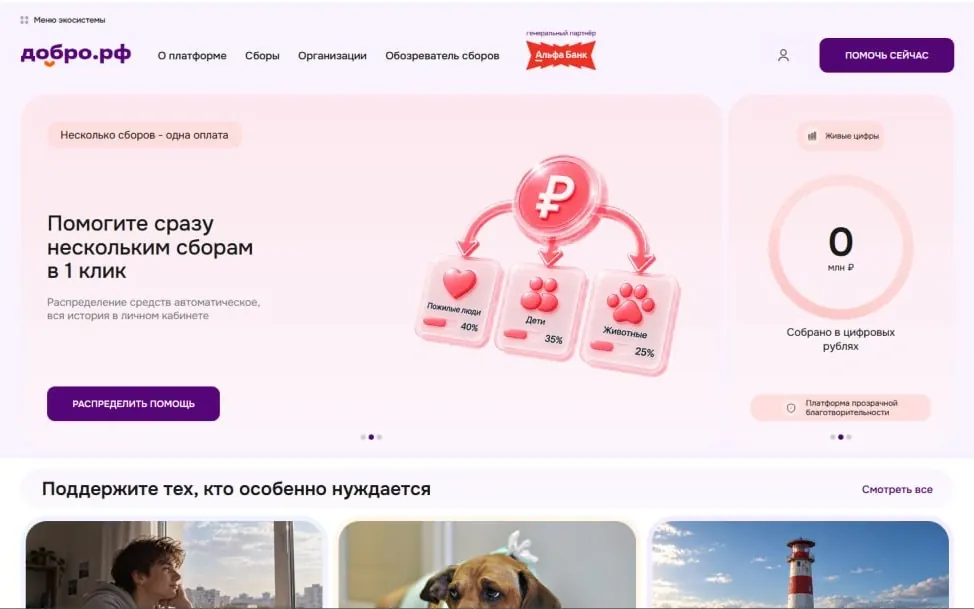
Dobro.rf (dobro.ru) is a platform for transparent charity, with Alfa-Bank as its general partner. Donors make one-time and recurring donations, put several fundraisers into one cart and see their history. Non-profits and private organizers go through onboarding, upload documents, create fundraisers and follow the statistics. Moderators review the fundraisers.
The situation
The client already had a platform, but it was not taken as the basis. They ordered a new one from scratch, with new technical requirements and a completely new design. So the architecture, the design system and the integrations were built anew, with no legacy code. Development has been going on since March 2026 to the client's specification.
The client also set the stack: React. Before the project, I was the only one on the frontend team who had written React, so the team had to learn the new stack fast. And there were many integrations: the digital ruble, payment in a modal window right on the site, Alfa-Bank, a multi-step onboarding for non-profits.
Process, architecture and decisions
The donation flow
A donor can support several fundraisers with one payment: the money is split automatically, and the whole history stays in the account.
- 01CatalogFilters by city, area of help, the registry of socially oriented non-profits and digital ruble support. In development: a catalog with request caching, the filter reference data moved out of the HTML so the page loads faster
- 02FundraiserProgress, days left, reports and the transaction log. In development: an ISR page that is served ready-made and updates itself
- 03CartSeveral fundraisers, one payment, split automatically. In development: cart state in Zustand, one payment form for all fundraisers
- 04PaymentA card in a modal window on the site, SBP or the digital ruble. In development: payment methods come from the backend, card details are typed into the secure fields of the payment gateway
Non-profit onboarding
An organization joins the platform through a six-step wizard. Moderator remarks are shown as field errors and block the submission until they are fixed.
- 01OrganizationSign-in via Gosuslugi, company details with suggestions. In development: DaData suggestions through a server route, the key never reaches the browser
- 02QuestionnaireInformation about the organization. In development: forms on react-hook-form and zod, moderator remarks shown as field errors
- 03AccountSign-in via Alfa ID and opening an account. In development: Alfa ID connection and a return to the same step of the wizard
- 04DocumentsPDF upload. In development: file upload with a format check
- 05SigningSigning the documents. In development: the step stays locked until all documents are uploaded
- 06CompletionThe review outcome, rejection included. In development: a separate screen for each review outcome
Architecture
- STOREFRONTPublic storefront
The home page, the fundraiser catalog, the fundraiser page, organizations, documents. The home page is static, fundraisers and non-profits use ISR, the catalog and organizations are dynamic with request caching. Public pages are served ready-made from the server: search engines find them, and a donor opens a fundraiser quickly from a link in social media or a newsletter.
- ACCOUNTSAccounts
Donor and non-profit accounts, the moderation section. Data is loaded on the client: SWR and Zustand, forms on react-hook-form and zod. The accounts are personal and search engines do not need them, so data loads in the browser and does not load the server, and form validation does not let a questionnaire go out with errors.
- SERVERNext.js server routes
A proxy to the API, DaData suggestions with the key kept on the server only, application metrics. Keys of paid services never reach the browser, so they cannot be stolen and their quota spent, and the metrics show growing load before users notice it.
app/api/backendapp/api/dadataapp/metrics
- APIBackend REST
Response types are generated from OpenAPI, so the frontend learns about a contract change at typecheck. Mismatches with the backend are caught before release, not on a donor's payment page.
Design system
Two designers on the team drew the layouts in Figma. From them the frontend built its own design system: theme tokens, CSS components for buttons, cards and inputs, 110 reusable components. Every reusable component is accepted through Storybook.
Integrations
- Bank cards · secure fields of the gateway
- SBP
- Digital ruble
- Alfa ID
- Gosuslugi
- DaData
- Yandex Metrica
I led the frontend integration work: for each one I chose the approach and the tools, set the tasks for the group and accepted the result in review.
Payment is one of the most complex parts of the platform: three methods, each with its own rules. A donor pays by card right on the site, in a modal window, without going to a bank page. The card number fields are embedded by the payment gateway, so the site neither sees nor stores the card details. With SBP, the donor confirms the payment in their bank's app, and the site waits for the answer and shows the result. The digital ruble is a new form of money from the Central Bank, and it can pay only for a one-time donation, while the cart and monthly donations are paid by card or via SBP. The backend decides which methods are available for each fundraiser and type of donation, and the site shows the donor only the suitable ones.
Data security
The DaData key lives only on the server, and requests go through a server route. The HTTP client sends no cookies in cacheable requests, so a personal response cannot end up in the shared cache. Private fundraisers ask for consent to publish personal data.
Quality and releases
Vitest and React Testing Library: 48 files, about 450 test cases, basic tests for every component. The performance seams have their own tests: cookies and cache in the HTTP client, caching of public endpoints, client-side loading of reference data. Another developer writes Playwright E2E tests: the cart and the donation, sign-in, non-profit onboarding.
- husky lint and unit tests on push
- pull request review and CI
- develop dev stand
- preprod prod
I set up the checks on push, the team's DevOps engineer set up GitHub Actions, Docker and the deployment.
We work in one-week sprints with a demo at the end of each. Tasks live in Jira, one branch per task, PRs with review. New developers get an onboarding document: layers, naming, patterns, forms, tests, Storybook. AI agents get the project rules and skills: branch review, tests, theme tokens.
Challenges
20 rps on any page
- Problem
- On every request the root layout waited for two API responses, up to a second: the auth check and the header data, of which one field was used. Because of reading cookies all 39 routes were dynamic, and nothing was cached.
- Solution
- Measured both options and moved auth to the client: 182 rps against 15.5 for the server one with a cached header. Marked public endpoints for tag-based caching, made the home page static, moved the fundraiser and non-profit pages to ISR, took the 130 KB filter dictionary out of the HTML, moved the accounts to client-side loading and converted 109 PNGs to webp.
- Result
- 17 routes: 340 → 4552 rps in total, median response 919 → 69 ms. 17 routes became static plus 2 with ISR, the catalog HTML went from 254 to 169 KB, images in the build from 13 to 1.4 MB.
A speed-up that turned out to be an empty page
- Problem
- After the fundraiser page moved to ISR, the benchmark showed a 15× gain. In fact the server returned an empty shell: useSearchParams() dropped the page into client-side rendering, and the HTML kept 659 characters of text instead of 2398. Neither typecheck nor 444 tests caught it.
- Solution
- Found it myself while reviewing my own branch. Reading the amount parameter moved into an effect, and the guidelines got a check for client-rendering markers and the amount of visible text after a route becomes static.
- Result
- The page stayed on ISR and handles 196 rps with the full content.
Metrics and results
- ×13more requests per second: 340 → 4552 rps
- 69 msmedian response instead of 919 ms
- 100Lighthouse in Accessibility, Best Practices and SEO, Performance 90+
- 37pages, 20 of them in the accounts
The load was measured with autocannon on a production build, 20 connections. Lighthouse was run with Unlighthouse across all pages of the site. There are no business metrics yet: the platform has not been released.
Need a large Next.js project or a team that picks up a new stack fast?
I will lay down the architecture and the guidelines, organize the frontend team and make the site hold the load.